


Accounts Payable automation
Streamline and automate the Accounts Payable process with Artificial Intelligence (AI).


Automating the Accounts Payable (AP) process offers organizations numerous benefits. It significantly increases efficiency by automating time-consuming manual tasks such as checking invoices, matching the invoices with the purchase orders (PO), and entering invoice data in the ERP system. Approval processes are also automated, and/or invoices are automatically routed to the right people based on business rules. As a result, organizations can streamline their Accounts Payable processes, enabling faster invoice processing, and reduces errors, giving employees more time for more valuable activities.
Capture Invoice Data
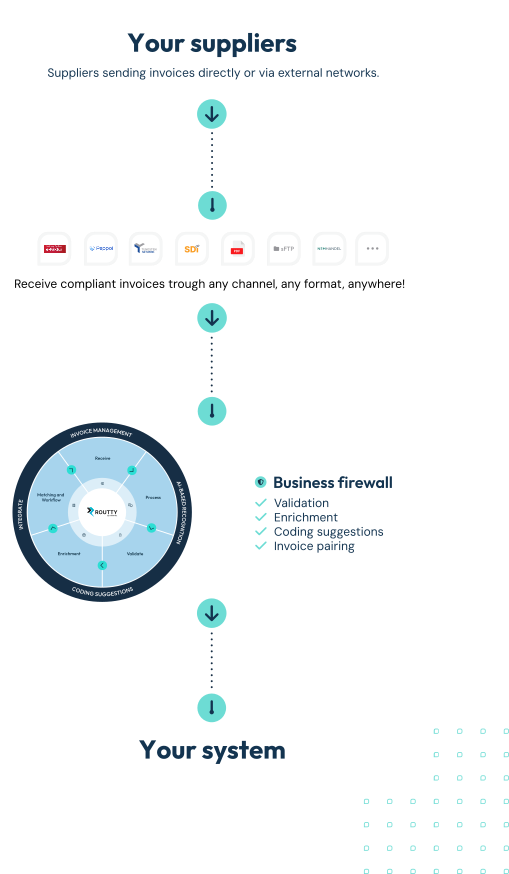
Upon receipt, our integrated Accounts Payable automation solution extracts invoice data immediately. The system handles various formats such PDF, XML, and EDI. This data comes through channels like email, Peppol, NemHandel, or any other e-Invoicing channel or governmental platform. Furthermore, Dynatos leverages advanced Optical Character Recognition (OCR)/Capture technology combined with Artificial Intelligence (AI) and Machine Learning (ML). Consequently, this ensures accurate recognition in this first step of the Accounts Payable process.

Verifying invoice data
After capturing the invoice data, it checks the data against the original purchase order (PO). For non-PO invoices, AI van automatically code them based on predefined business rules and historical patters. For PO invoices, the system automatically applies 2-way, 3-way, or 4-way matching against the data in your system. When it detects discrepancies, or based on established rules, it triggers an automatic role-based workflow to resolve these quickly.
If needed, users van also code invoices manually, and they can trigger the approval process automatically or manually, depending on the organization’s needs.
Processing invoice data
Once the system captures and verifies the invoice data, it processes this data in the ERP system or in a specialized AP automation solution.
This automated approach to the Accounts Payable process ensures compliance with internal rules and controls, and it increases efficiency by minimizing manual intervention.
Automating the Accounts Payable process requires minimal human interaction while maintaining business regulations and control.
Automate Accounts Payable
Cloud-based or on-premises AP solutions
Accounts Payable automation software is available as on-premise solutions but also cloud based. Therefore, invoices can be approved, declined or request edits from everywhere through all devices. It also enables access to invoices and financial data to make strategic business decisions based on accurate financial information.
Accounts Payable automation ignites Digital Transformation in finance
Both internal and external stakeholders nowadays expect more from finance departments than simply bookkeeping and preparing financial statements. They increasingly expect that finance supports them pro-actively in decision support, risk & compliance, and performance management. Financial departments are therefore transforming from a traditional operational function to a true business partner for its stakeholders.
Strategy, change management, and technology are crucial elements in every finance transformation process. Accounts Payable automation frees up time to go through the finance transformation while improving productivity, efficiency, and quality.
Frequently asked
Automation of Accounts Payable processes can lead to increased efficiency, reduced errors, faster processing times, improved compliance, better vendor relationships, and cost savings.
Yes, there is no maximum number of invoice pages in a document that Accounts Payable automation software can process. The solution can automatically determine the last page of an invoice.
Without automation, businesses typically handle Accounts Payable manually, which involves a more time-consuming process of receiving, verifying, and processing invoices.
More about Accounts Payable automation



Advisory, News
PHP vulnerabilities: what users of Tungsten, Coupa, ISPnext and Routty need to know
Recent PHP vulnerabilities have prompted questions about invoice processing software. This overview explains the impact on Tungsten Process Director, AP Essentials, Coupa, ISPnext and Routty, including where patches or further action may be needed.