




In 2026, the Spanish government approved Royal Decree 238/2026, providing further implementation details for Spain’s mandatory B2B e-invoicing framework under the Ley Crea y Crece initiative. The decree clarifies key elements of the future model, including interoperability requirements, platform obligations, invoice lifecycle reporting, and payment status reporting.¹
While Royal Decree 238/2026 provides significantly more clarity than was previously available, it does not answer every operational question. Several implementation details still depend on a forthcoming Ministerial Order, which is expected to define how organizations will comply in practice.²
For finance and IT teams, that distinction matters. The Royal Decree establishes the regulatory framework, while the Ministerial Order will determine many of the practical requirements around platform specifications, interoperability, reporting obligations, and implementation timelines. Although the mandate’s direction is now clear, some of the operational requirements that will shape implementation projects are still being finalised.²
This article explains what is known today, what remains uncertain, and what the practical implications are for both Spanish companies and organizations that do business with customers or suppliers in Spain.
Last updated: June 2026 | 8 min read
What is changing?
Spain is introducing mandatory structured electronic invoicing for B2B transactions between businesses and self-employed professionals.¹
The objective extends beyond replacing PDF invoices. The Spanish government aims to:
- Improve payment transparency
- Reduce late payments
- Increase traceability
- Support tax controls
- Accelerate digitalization across the Spanish economy¹
Unlike PDF invoices sent by email, invoices must be exchanged in a structured format that can be processed automatically by business systems. In addition, invoice recipients will be required to communicate invoice status information electronically, including acceptance, rejection, and payment status, together with the corresponding dates.³
This makes Spain one of the most comprehensive e-invoicing initiatives currently being implemented in Europe.
The Royal Decree establishes the framework. The Ministerial Order will determine how organisations comply in practice.
The timeline is becoming clearer, but not fully fixed
One of the largest areas of uncertainty has been the implementation timeline.
Although the Royal Decree has been approved, the compliance dates are linked to a separate Ministerial Order that will define the technical specifications for the public platform and operational requirements. Publication of this order is expected during 2026.²
Current expectations are:
| Organization type | Expected compliance date |
| Companies with a turnover above €8 million | Approximately 12 months after publication of the Ministerial Order |
| Companies with a turnover below €8 million | Approximately 24 months after publication of the Ministerial Order |
Several regulatory analyses point to October 2027 as the most likely start date for larger organizations and October 2028 for smaller businesses. However, these dates should be considered indicative until the Ministerial Order is formally adopted.⁴
The legislative framework is now largely established, although several implementation details still require formal confirmation.
Spain is building a hybrid model
One reason the Spanish mandate deserves attention is the architecture behind it. Spain is not introducing a pure clearance model like Italy. Nor is it adopting a Peppol-only approach, as Belgium has done.
Instead, Spain is implementing a hybrid ecosystem in which companies can exchange invoices through:
- Private e-invoicing platforms
- A public platform operated by the Spanish Tax Agency (AEAT)¹
These platforms must be interoperable. Organizations cannot require trading partners to join a specific proprietary network. Certified platforms must be capable of exchanging information with one another when required.¹
Another distinguishing feature of the Spanish model is that compliance extends beyond the exchange of structured invoice data. Invoice recipients will also be required to communicate specific lifecycle events, including invoice acceptance, rejection, and payment status.³
In many European e-invoicing frameworks, the primary objective is ensuring that invoices are exchanged in a structured format. Spain introduces additional obligations requiring organizations to track and report on what happens after an invoice is received.³
As a result, the most distinctive aspect of the Spanish model is not the invoice format itself. Most organizations already support, or can generate, structured invoice formats. The greater challenge lies in the combination of interoperability requirements, invoice lifecycle reporting, and payment status reporting.¹ ³
Together, these requirements extend compliance beyond invoice delivery. Organizations need visibility into whether invoices have been accepted or rejected, when payment obligations have been fulfilled, and how this information is communicated across platforms and systems. This creates additional requirements around ERP integration, workflow management, auditability, and process governance.
For many finance teams, these operational requirements may ultimately have a greater impact than the invoice format itself.
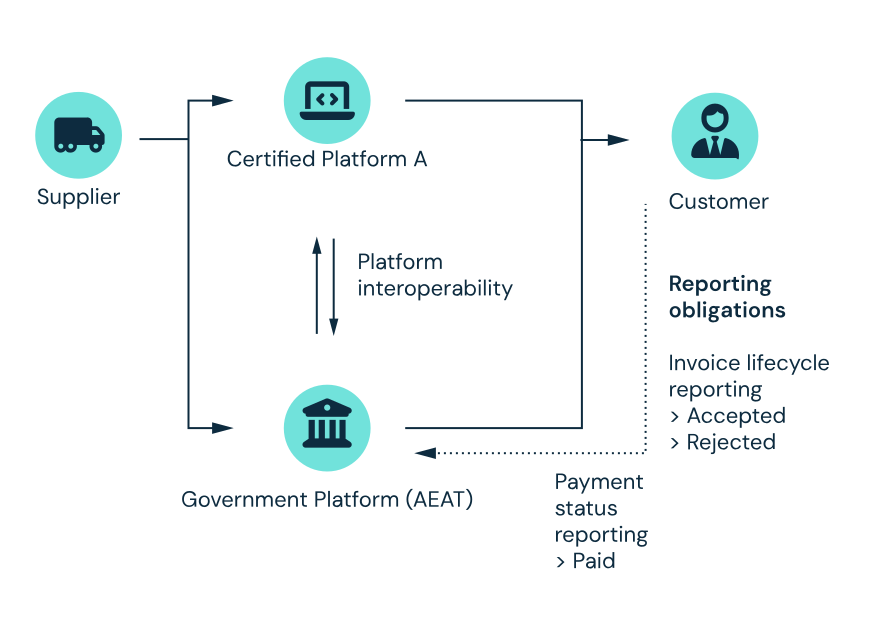
Figure 1. Overview of Spain’s B2B e-invoicing environment.
Interoperability, lifecycle reporting, and payment status reporting are the defining characteristics of Spain’s e-invoicing framework.
Structured invoices are mandatory, but multiple formats will coexist
Many organizations assume Spain will require a single invoice format. Current technical guidance suggests otherwise.
Supported invoice syntaxes are expected to include:
- UBL
- Facturae
- CII
- EDIFACT (under specific conditions)⁵
Peppol BIS invoices are also expected to be accepted because they are based on UBL and comply with EN 16931 requirements.⁵ This approach provides flexibility for organizations already using established invoice formats.
However, it also introduces complexity.
Companies may need to receive, process, validate, and potentially transform multiple invoice syntaxes while maintaining compliance. As a result, ERP integration, e-invoicing platforms, and transformation capabilities become increasingly important.⁵
Spain is not an isolated case
Spain’s mandate should also be viewed within a broader European context.
Through the VAT in the Digital Age (ViDA) initiative, the European Union is moving towards increased digital reporting and greater use of structured electronic invoice data.⁶ While member states continue to implement different national models, the overall direction is becoming increasingly clear.
Structured invoice exchange is gradually evolving from a local compliance requirement into a standard expectation across Europe. For multinational organizations, decisions made today for Spain may influence future compliance strategies in other countries.
As more European countries move towards structured invoice exchange and digital reporting, organizations increasingly benefit from developing a scalable compliance approach rather than treating each mandate as a standalone project.
The biggest impact is not compliance. It is a process change.
Across Europe, organizations often underestimate the operational impact of e-invoicing mandates. Generating an XML invoice is rarely the most difficult part.
The greater challenge usually lies in:
- Supplier onboarding
- Customer communication
- ERP integration
- Exception handling
- Invoice status management
- Master data quality
- Cross-border interoperability
Experience from mandates in Germany, Belgium, France, and Poland shows that organizations frequently encounter process challenges during implementation, particularly around onboarding, integration, and governance. Similar challenges may emerge in Spain as organizations move from compliance planning to operational execution.
The lesson from other European rollouts is that compliance is rarely the biggest obstacle. Operational readiness usually determines how smoothly organizations adapt to new requirements.
Successful e-invoicing programmes are usually determined by operational readiness rather than technical capability.
What does this mean for Spanish companies?
Spanish organizations should view the mandate as a business change initiative rather than solely a compliance exercise.
Three areas deserve particular attention.
1. ERP readiness
Many ERP environments were originally designed around PDF invoices and manual processes.
Organizations should assess:
- Outbound invoice generation capabilities
- Structured invoice support
- ERP integration requirements
- Invoice status tracking
- Archiving and audit requirements
This is particularly relevant for organizations running SAP ECC or other legacy ERP environments, where additional integration capabilities may be required.
2. Customer and supplier onboarding
Compliance depends on the ability to exchange invoices with trading partners.
Organizations should understand:
- Supplier readiness
- Customer requirements
- Preferred exchange channels
- Supported invoice formats
Experience from other mandates suggests that onboarding often becomes one of the most time-consuming parts of implementation.
3. Process ownership
Many organizations initially treat e-invoicing as an IT project. In practice, successful implementations typically involve stakeholders from finance, tax, procurement, compliance, and IT. The mandate affects invoice exchange, payment tracking, reporting obligations, and customer interactions.
What does this mean for companies outside Spain?
A common misconception is that the Spanish mandate only affects Spanish businesses. In reality, many international organizations may be affected indirectly.⁷
This may apply if you:
- Sell to Spanish businesses
- Buy from Spanish suppliers
- Operate through a Spanish subsidiary
- Have a permanent establishment in Spain
In these situations, organizations may need to support Spanish-compliant invoice exchange and reporting requirements.⁷
For multinational organizations, the challenge is often broader than compliance with a single national mandate.
For multinational organisations, the challenge is managing multiple national frameworks without creating multiple local solutions.
Although many European countries are moving towards EN 16931-based e-invoicing, implementation remains fragmented. Different countries continue to apply their own exchange models, reporting obligations, and technical specifications. Spain’s framework adds another layer to an already complex European compliance landscape.
Organizations that address each mandate independently risk creating a collection of local solutions that are difficult to maintain. Those that develop a broader European e-invoicing strategy may be better positioned to manage future regulatory changes.
Do not confuse the B2B mandate with VeriFactu
Another common source of confusion is VeriFactu. VeriFactu and mandatory B2B e-invoicing are separate initiatives.⁸
VeriFactu focuses on invoicing software controls and anti-fraud requirements.
The B2B mandate focuses on structured invoice exchange between businesses.
Although both initiatives affect invoicing processes and have implementation milestones around the same period, they serve different regulatory objectives and require separate preparation efforts.⁸
For some organizations, it may be practical to address both initiatives within a broader invoicing transformation program. However, they should not be treated as the same project.
What should companies do now?
The exact implementation timeline still depends on the publication of the final Ministerial Order. That uncertainty should not obscure the broader picture.
The key questions organizations need to answer are already visible:
- Which invoice exchange model best fits our organization?
- Can our ERP generate and receive compliant, structured invoices?
- How will we manage multiple invoice formats?
- How will we onboard suppliers and customers?
- How do Spanish requirements fit within our wider European e-invoicing strategy?
The organizations that begin assessing these questions early will have more time to address process gaps, integration challenges, and onboarding requirements.
Experiences from other European mandates suggest that operational readiness is often the determining factor in a successful rollout.
Looking ahead
Spain’s B2B e-invoicing framework is about more than exchanging structured invoices. Interoperability, lifecycle reporting, and payment status reporting introduce new operational requirements that extend across finance, IT, and compliance teams.
While several implementation details still depend on the forthcoming Ministerial Order, the overall direction is now clear. Organisations that use this period to assess processes, systems, and reporting capabilities will be better positioned when the final requirements are published.
If you would like to discuss how these developments may affect your organisation, our e-invoicing specialists are happy to share their experience from e-invoicing programmes across Europe.
Key takeaways
- Spain’s e-invoicing framework extends beyond invoice exchange.
- Interoperability, lifecycle reporting, and payment status reporting are central to the Spanish model.
- Royal Decree 238/2026 establishes the framework, while the Ministerial Order will determine many practical implementation requirements.
- Current expectations point to implementation from 2027 for larger organisations and 2028 for smaller businesses.
- Companies operating internationally should assess how Spanish requirements fit within their broader European e-invoicing strategy.
- Spain’s B2B e-invoicing mandate and VeriFactu are separate initiatives.
Frequently asked questions about Spain’s B2B e-invoicing mandate
The exact implementation dates depend on the publication of the Ministerial Order. Current expectations point to implementation from 2027 for larger organisations and from 2028 for smaller businesses.
No. Spain is implementing a hybrid model that allows invoice exchange through certified private platforms and a public platform operated by the Spanish Tax Agency. Peppol may be used, but it is not the only supported exchange method.
Spain combines interoperability requirements with invoice lifecycle reporting and payment status reporting. Together, these requirements extend compliance beyond invoice exchange.
Invoice lifecycle reporting requires organisations to communicate events such as invoice acceptance, rejection, and payment status after an invoice has been received.
Potentially. Organisations that sell to Spanish businesses, buy from Spanish suppliers, or operate through a Spanish subsidiary may need to support Spanish-compliant invoice exchange and reporting requirements.
Current guidance points to support for formats such as UBL, Facturae, CII, and EDIFACT under certain conditions.
No. VeriFactu focuses on invoicing software controls and anti-fraud requirements, while the B2B mandate focuses on structured invoice exchange and reporting obligations between businesses.
Sources
¹ Boletín Oficial del Estado (BOE)
Real Decreto 238/2026, de 25 de marzo, por el que se desarrolla la factura electrónica obligatoria entre empresarios y profesionales
² Peppol.nu
Spain mandatory e-invoicing 2027 | Crea y Crece Royal Decree approved
³ EY
Spanish Government approves Royal Decree implementing mandatory B2B electronic invoicing
⁴ RTC Suite
Spain’s Mandatory B2B e-Invoicing Takes Shape: Royal Decree 238/2026 and the Draft Ministerial Order
⁵ VAT Update
Spain Publishes Royal Decree Implementing Mandatory B2B Electronic Invoicing
⁶ European Commission (ViDA)
VAT in the Digital Age (ViDA)
⁸ KPMG
Spain: Council of Ministers approves e-invoicing mandate for B2B transactions